Does My Child Need a Physiotherapist? Signs Worth Checking
Not sure whether your child needs to see a paediatric physiotherapist? The signs worth acting on, the ones that usually aren't a problem, and what an assessment actually involves.
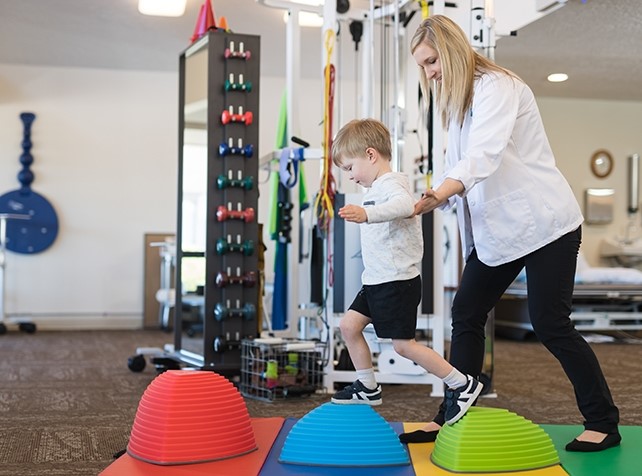
Most families who book a paediatric physiotherapy assessment don't arrive with a diagnosis. They arrive with a nagging feeling — that their child tires faster than other kids, trips more than seems normal, or still isn't doing something their friends' children started months ago.
That instinct is usually worth acting on. It also needs context: children develop across a genuinely wide range of "normal", and plenty of the things parents worry about settle on their own. This guide is about telling the difference — which signs are worth a closer look, which usually aren't, and what actually happens if you book an assessment.
At Square One Therapy Hub in Kogarah, we see children from infancy through to late adolescence across the St George area and Sutherland Shire. You can read more about how we work on our paediatric physiotherapy page.
Signs worth checking
Movement milestones
Milestones are guides rather than deadlines, but a persistent gap is meaningful. Consider an assessment if your child:
- Isn't sitting independently by around 9 months
- Isn't pulling to stand by around 12 months
- Isn't walking independently by 18 months
- Skipped crawling and is finding other movement harder as a result
- Has lost a skill they previously had — this one always warrants prompt review with your GP or paediatrician as well
Balance, coordination and confidence
- Trips or falls noticeably more than same-age peers
- Avoids playground equipment, stairs or uneven ground
- Can't hop, jump with two feet together, or balance briefly on one leg by around age 4
- Hangs back from running and ball play they used to enjoy
Strength, tone and stamina
- Appears "floppy", slumps when sitting, or constantly props on furniture
- Asks to be carried on walks other children in the family manage
- Fatigues quickly during play, or complains of aching legs afterwards
- Sitting posture at a desk that doesn't improve with reminders
Walking patterns
- Persistent toe walking past age two
- In-toeing or out-toeing that seems to be getting more pronounced
- A limp, or a pattern that's clearly different on one side
- Asymmetry — always turning, reaching or rolling to the same side
Babies
- A strong head-turning preference, or a flat spot developing on one side of the head
- Real difficulty tolerating tummy time well past the newborn weeks
- Stiffness or resistance through the neck or hips when being dressed
Recognising several signs within one group is more informative than one sign on its own.
Things that usually aren't a problem
Just as useful to know:
- Occasional toe walking under age two. Common while walking is still being refined.
- Flat feet in young children. Most children's arches develop through the primary school years.
- Bow legs in toddlers, knock knees in preschoolers. Both are typical stages for most kids.
- Being last in the friendship group to walk. The independent walking range is genuinely wide.
- Clumsiness during a growth spurt. Adolescents commonly go through a temporarily awkward phase.
None of these rule out an assessment if something else is bothering you. They're just not, on their own, a reason to worry.
What happens at an assessment
An initial appointment runs about 45–60 minutes and looks a lot like play. We will:
- Talk through your concerns, your child's history, and what you'd like to be different
- Watch your child move — walking, running, climbing, getting up off the floor
- Check joint range, muscle length, strength and balance
- Use standardised measures where they're helpful, so progress can be tracked objectively
- Explain the findings in plain language and set out the options
Sometimes the outcome is a short home programme and a review in a few months. Sometimes it's a block of sessions. Sometimes it's reassurance that nothing needs doing — a legitimate and common result, and one worth having.
Where movement is the central difficulty, our gross motor difficulties page covers what support can look like in more depth. For older kids and teens, we've also written about supervised strength training for adolescents.
Why earlier tends to be easier
The years when children are learning to move are also the years when movement patterns are most adaptable. When a child compensates for tight calves, weak hips or unreliable balance, the compensation itself gets practised — and unpicking a well-rehearsed pattern generally takes longer than guiding a developing one. That's the main argument against waiting another twelve months to "see how they go" when something is clearly bothering you.
How paediatric physiotherapy is funded
Families at Square One typically use one of four pathways:
- NDIS — physiotherapy usually sits under Capacity Building: Improved Daily Living. We work with self-managed and plan-managed participants. More detail on our NDIS funding page.
- Medicare — a GP Chronic Disease Management plan can cover up to five allied health sessions a year. Claims are processed on the spot, so you pay only the gap.
- Private health — extras cover including physiotherapy, claimed via HICAPS at the appointment.
- Private — no referral required, at any age.
Next steps
If something about the way your child moves has been sitting at the back of your mind, an assessment will give you either a plan or reassurance. Either beats wondering.
Square One Therapy Hub is at 4 Short Street, Kogarah — a short walk from Kogarah station, and easy to reach from Hurstville, Rockdale, Carlton, Ramsgate and the Sutherland Shire. Get in touch to book an assessment, or to ask a question first.
Pavan Kasthuri is a physiotherapist and co-director of Square One Therapy Hub. He has practised since 2019, working in paediatrics since 2023, with postgraduate training including APA Paediatrics Level 1.
More from the blog

NDIS and Occupational Therapy: What's Actually Covered
OT under an NDIS plan — which supports are funded, how to use them, and how self- and plan-managed participants access services at Square One.

Late Talker or Speech Delay? A Sydney Parent's Guide
How to tell the difference between a late talker who'll catch up and a delay that needs support — milestones by age, red flags, and what helps in the meantime.

Messy Handwriting: When It's Worth Seeing an Occupational Therapist
Illegible writing, sore hands, avoiding written work — what's behind handwriting difficulties, what to expect at each school year, and when an OT assessment is worth it.